Affichage des articles dont le libellé est Rouhani. Afficher tous les articles

Iran And The U.S.: Still Possible To Escape The Worst And Work For The Best


The United States’ withdrawal from the JCPOA could certainly be considered as an ill-advised, even absurd decision, but, like it or not, could not be labelled as running counter to international law. Let us remember the care taken by the American negotiators in Vienna to avoid giving the JCPOA any formal attributes of an international treaty -- which would have required a formal approval by the Congress --. They even took care to avoid presenting it as an “agreement” not only in its title, but even in the body of the text. The document was never signed by the parties, only adopted by a silent consensus of the seven parties following a declaration by the representative of the European Union. True, the JCPOA, soon after its adoption in Vienna, has been “endorsed” by a formal resolution of the United Nations Security Council, but again the Americans, when partaking in its drafting, took great care to deprive the formula of any binding force under the United Nations Charter.

Destroying from outside the JCPOA up to the core

What happened after the withdrawal is another matter. Washington started developing an aggressive strategy against the six remaining parties aimed at destroying the JCPOA from outside. Reintroducing sanctions could have been accepted as a logical consequence of the American withdrawal as long as it did not produce direct adverse effects on the smooth implementation of the Vienna arrangement. Unfortunately, the extra-territorial dimension of most of these sanctions created a steadily growing imbalance between the Iranian nuclear commitments and their expected benefits for Iran. Though, up to now, Donald Trump’s administration had spared the inner mechanisms of the JCPOA. By threatening to forbid Tehran to send abroad the low enriched uranium and the heavy water it may produce in excess of the limits agreed in the Vienna arrangement, Washington has gone one step further. It undermines the letter and the spirit of the very core of the JCPOA.
Furthermore, in its May 3 statement, the State Department explicitly demands Iran “to stop all proliferation-sensitive activities, including uranium enrichment”. Here we return to square one, in 2003, when John Bolton, already him, was bullying the three Europeans negotiating with Iran into gaining Tehran’s submission to the famous “zero centrifuge” formula. There was of course zero chance of success, the negotiation collapsed two years later. However, it never stopped entirely and morphed into different formats until the final and decisive push given by Barack Obama and John Kerry. This last effort led to the Vienna arrangement or JCPOA, based, precisely, on the de facto recognition, within determined limits, of the Iranian enrichment program.

The collective failure of Iran’s JCPOA partners

All of this to say that the six remaining parties to the JCPOA, and not only Iran, should have felt equally attacked by the last American move. One would have liked to hear from the Europeans the word “protest” instead of the meek “regret” and “concern”. China, embroiled in a difficult negotiation with the United States, prudently called “on all relevant parties to exercise restraint etc.”. Only Russia dared to “blame” the US and to express its “understanding” of Iran’s position. An opportunity was missed by Iran’s JCPOA partners to demonstrate through a common statement their solidarity against the squarely hostile gesture from the United States. Let us hope that the next meeting of the Joint Commission provided for by the JCPOA will offer a new chance for the parties, including Iran, to speak up in one voice.
The Europeans were braver when it came to react to the Iranian answer. Putting forward their “great concern”, they urged Iran “to refrain from any escalatory steps” and rejected “any ultimatums”. By using this last term, did they intend to target Washington as well Tehran? In reality, Tehran’s “ultimatum” to progressively step up its nuclear activities absent any progress in alleviating the American sanctions reads as one of the most carefully poised and soft-spoken ultimatums in History. It rather sounds like a call for help from President Rouhani, caught between the United States and his own radical opposition.

Primum non nocere

Where can we go from now? INSTEX, the barter mechanism intended to facilitate at least the run-of-the mill trade between Iran and the European Union is yet to take off and will need no less than a year, probably more, to operate at full capacity. China is not at the present time in a position to take a bold initiative. Russia could perhaps help Iran to sell part of its oil, but this carries serious risks. All in all, no easy solution is in the offing in the two to four-month lapse of time given by Tehran to its JCPOA partners to alleviate on a priority basis sanctions on its oil exports and its banking system.
In waiting for better opportunities, the primary requirement for Iran’s partners in the JCPOA should be to defuse all risks of further tensions between them : primum non nocere. The Europeans should therefore avoid threatening to refer Iran to the Security Council for non-compliance with its commitments. The urgency for now is to save the spirit of the JCPOA, even against its letter, as long as Iran does not give rise to a significant danger of proliferation. We are still far from this point.
Of course, Iran too has to play its part. To get around the latest American decisions in the immediate future, it can down-blend to natural level the enriched uranium produced in excess that cannot be exported anymore. It can also down-blend its heavy water in excess to common water. Regardless of the JCPOA, Iran has today no interest in accumulating at great cost and efforts, using a fully outdated model of centrifuge, big stockpiles of enriched uranium of which it has no use in the short or even medium-term. It would better prepare for the future by prioritizing, within the perfectly legal framework offered by by the JCPOA, the development of its new models of centrifuges. And instead of trying to revive the uncertain construction of the natural uranium research reactor abandoned when joining the JCPOA, it should rather press its partners to help speed up the construction of the new reactor pledged in the same JCPOA, which has been desperately dragging on. This would be a positive ultimatum!

Towards a way-out of the crisis

But all of this covers only one part of the picture. The other is in Washington, where drums of crisis and war have started beating. While displaying their solidarity with all the remaining parties to the JCPOA, the Europeans, in spite of all difficulties, still have the capacity to bend the situation into a better direction. Of course, they will not convince President Trump to return to the JCPOA, nor the Iranians to renegotiate the JCPOA with the Americans. But they could capitalize on Donald Trump’s obvious longing, as seen on multiple tweets and remarks, to produce at long last proof of his “art of the deal” by striking some kind of arrangement with Tehran. All the better if it would take place before the next Presidential election. For this, a limited agreement would suffice, if it both clearly benefits the United States and reduces the Iranian risk of proliferation. This is where the Europeans could enter the game in the role of the honest broker. The first prerequisite would be to take into account the mutual distrust of the two parties. They should therefore be able to put forward equally balanced, fully voluntary and reversible gestures. The task is difficult, but not impossible

What the Americans can give

To start with the American side, a first possible gesture could be to reinstate the waivers allowing the sale to Iran of commercial passenger aircraft, as provided for by article 22 of the JCPOA. Negotiations between Iranian companies and Boeing as well as Airbus did start upon the conclusion of the Vienna arrangement. They were interrupted by the American withdrawal. All in all, they addressed the acquisition of more than two hundred planes equally spread between Boeing and Airbus. The completion of this negotiation would be, of course, highly beneficial to Iran, due to the sore state of its fleet, but also to Boeing, going through a difficult pass, and to the American economy at large. The perspective of creating thousands of jobs in the American aircraft industry would be a positive signal in an election year. Last but not least, it would also benefit the European economy.
Another possible American gesture would be to reintroduce some waivers for Iranian oil’s main clients. This would reduce tensions on the oil international market and facilitate America’s relations with its traditional friends : Japan, South Korea, Taiwan among others, without forgetting Europe. And again, reasonable gasoline prices at American pumps in an election year would be a welcome feature. A third possible gesture would be to ease the restrictions imposed on the Iranian banking sector, provided, of course, that Iran finally brings its legislation into conformity with international norms against the financing of terrorism.

What the Iranians can give

How could Iran come at par with such a bounty of gestures? Starting with the third and last point, we know that the adoption of anti-terrorism international norms currently feeds a bitter internal debate in Iran. But precisely, the perspective of an attractive package could lead to a favourable arbitration by the Supreme leader and thus settle the matter. However, this would not be enough by far, to satisfy the American side. At least another important Iranian gesture would be needed to tip the scales.
Like Edgar Poe’s letter, it is right before our eyes. As long as Iran is committed by the JCPOA provisions not to exceed a stockpile of 300 kilograms of low-enriched uranium (LEU), it has absolutely no interest in spinning the 5,000 or so centrifuges authorized by the same JCPOA. Their potential output goes far beyond this limit. 1,500 centrifuges would amply suffice to produce a couple of hundred kilograms of LEU per year. And again, the real challenge for Iran is not to run a big bunch of outdated centrifuges (the present IR1 model dates back from the early Seventies) but to be able to produce and operate efficient, up-to-date, centrifuges when the JCPOA comes to its end. There would be therefore no drawback for Iran in announcing a voluntary switch-off of about two thirds of its presently active centrifuges. All of this under the supervision of the International Agency for Atomic Energy, in return for the United States’ own commitments – and just how long as it keeps its commitments.
*
With perhaps on top of such reciprocal gestures a common understanding to envisage the reopening of a collective negotiation when the JCPOA arrives to its end, we have at hand the main elements of a fair deal both parties could be proud of : Donald Trump for having obtained much more than Barack Obama in curbing Iran’s nuclear activities without giving more than what was already contained in the JCPOA ; Rouhani for having alleviated a part of the most disruptive American sanctions while preserving the legitimacy and the future development of the Iranian nuclear program. Now, the combination of all these elements into a successful venture is the job of the diplomats. And to continue with pride, the Europeans, as we know, are rightly proud of their long diplomatic tradition. With some luck and hard work, they could be proud tomorrow for having helped defuse a serious crisis in our time.

(published on May 14, 2019, by LobeLog)

Losing an ennemy

Trita Parsi has written a great book about what remains the most outstanding diplomatic feat of the 21st century. It is the first work to describe in detail the whole course of the extraordinarily complex international negotiation that led to the conclusion in Vienna on July 14, 2015 of the now famous Joint Comprehensive Plan of Action, or JCPOA—the arrangement between Iran and the five permanent members of the UN Security Council (China, France, Russia, UK, US), plus Germany to cap Tehran’s nuclear program in exchange for the lifting of economic sanctions against the Islamic Republic.
Even though we know the (provisional) end of the story, the book reads like a thriller, so high the tensions that built up as obstacles to an agreement repeatedly arose. This is certainly the case, among other examples, with the secret U.S.-Iranian diplomatic contacts that took place in Oman, the hectic final run of the negotiations in Vienna, and the epic battle in and around the US Congress immediately afterwards to protect the accord from its many and fierce critics.
The latest of what so far has been a trilogy of books written on the twists and turns of recent US-Iranian diplomacy, Losing an Enemy: Obama, Iran, and the Triumph of Diplomacy (Yale University Press) opens with a useful recap of the major findings in Parsi’s award-winning Treacherous Alliance: The Secret Dealings of Israel, Iran and the United States (2010) and A Single Roll of the Dice: Obama’s Diplomacy with Iran (2012).
The first four chapters of Losing an Enemy effectively set the scene for the drama of the successful negotiation to follow. Two introductory observations provide the key drivers of the whole storyline. The first one reads: “It would be erroneous to view these negotiations and the deal they produced solely as a nuclear matter. In essence, they formed the final chapter of a thirty-five-year battle over the geopolitical order in the region in general and Iran’s place in that order in particular.” And the second: “While the deal was based on a ground-breaking scientific formula, the real challenge to the negotiations was not technical but human.” These two sentences reverberate throughout the book.
The curtain rises on the first international conflict after the end of the Cold War: the 1991 Gulf War. Parsi rightly presents it as a seminal event in the new distribution of power in the Middle East. I remember personally how, with the disappearance of the Eastern bloc, the United States and its main allies looked around for new threats capable of legitimizing the maintenance of a global military posture. Neither China nor India was sufficiently powerful to pose a credible threat. Instead, it had to come from the vaguely ominous Islamic world, and more precisely the turbulent Middle East. In Parsi’s view, Israel played a critical role in focusing Western, and especially Washington’s, attention on that region.
For its part, Israel had lost its favorite bogeyman with the defeat of Saddam Hussein, the regional leader who wanted to offer the nuclear bomb to the Arab world. At that point, Israel’s neighbors no longer posed a credible threat, as indicated by their participation in the post-war Madrid Conference under the joint presidency of the United States and a somewhat absent-minded Soviet Union (which was to disappear altogether a few weeks later). There was “a feeling in Israel that, because of the end of the Cold War, relations with the U.S. were cooling, and we needed some new glue for the alliance,” Parsi quotes one eminent Israeli scholar as telling him in one of dozens of interviews cited in the book. “The new glue was radical Islam, and Iran was radical Islam.”
Despite its helpful neutrality in the 1991 war, Iran was not invited to Madrid, a snub that constituted the first lost opportunity to draw Tehran out of its isolation and encourage it to adopt a more cooperative attitude toward the Israeli-Palestinian conflict. At the same time, the Israeli leadership started developing an increasingly aggressive narrative depicting Iran as an “existential threat” to the Jewish state, and indeed, to the whole civilized world. As a resultaccording to Parsi, hardliners in Tehran opposed to the more open policies of then-President Ali Akbar Hashemi Rafsanjani gained strength, and, less than two years later, Iran forcefully rejected the Oslo agreement between Israel and the Palestine Liberation Organization.
The “dual-containment” policy adopted by the Clinton administration, which paired Iran with Saddam Hussein as a threat to U.S. national interests, marked the beginning of a long line of US efforts to make Iran a pariah state: politically, of course, and, more practically, through the application of comprehensive economic sanctions. Parsi digs up from the archives some emblematic declarations of the period that would become mantras under Trump more than 20 years later. There’s this nugget, for example, from Clinton’s first secretary of state, Warren Christopher: “Iran is the world’s most significant sponsor of terrorism and the most ardent opponent of the Middle East peace process…The evidence is overwhelming: Iran is intent on projecting terror and extremism across the Middle East and beyond.” Sound familiar?
September 11 and After
Then came September 11. The author describes at length Iran’s highly effective policy of active collaboration with the United States and the international coalition in their drive to break the Taliban’s hold on Afghanistan. All of this, however, was to no avail as Iran found itself included in George W. Bush’s “Axis of Evil” in his January 2002 State of Union address. With the fall of Baghdad 14 months later came talk by senior Bush officials and other Washington hardliners of “real men” wanting to go to Tehran.
In the meantime, the world discovered the budding Iranian uranium enrichment program. Three European nations, having kept their embassies in Tehran, started speaking with officials there in an attempt to negotiate a compromise guaranteeing that such a program would not end up producing nuclear weapons. In this context, a senior European official confides to Parsi that “the need for EU involvement in the nuclear issue was not so much to contain Iran, but to contain America.” Iran was spared a possible invasion, but Europe’s engagement was fated to die a slow death as Washington insisted that Iran completely abandon its enrichment project, the so-called “zero-centrifuge” or “zero-enrichment” position that would stall progress on negotiations well into the next administration.
Barack Obama chose to explicitly renounce the long-standing US policy of “regime change” regarding the Islamic Republic of Iran and engage in a negotiated solution to the nuclear crisis. But these moves in themselves were insufficient to change the course of events, according to Parsi who devotes four (of 17) chapters to describing the highly intricate games deployed by and between a broad array of actors, almost all of them holding divergent visions and interests and trying to divert Obama from his goal.
From this gallery of portraits emerges the figure of Benjamin Netanyahu, ever resourceful when it comes to raising obstacles to possible US engagement with Iran. At the same time in Tehran itself, the increasingly rancorous conflicts between Supreme Leader Ali Khamenei and President Mahmoud Ahmadinejad consistently worked against any opportunity for progress. Slowly, according to Parsi, “the political maneuverability Obama enjoyed on Iran when he first took office was completely eaten away by pressure from Israel and Congress, the fallout from the June 2009 Iranian presidential election, and Iran’s refusal to accept the Russian-American swap proposal in October 2009.” Meanwhile, the US administration’s “dual-track policy,” which combined diplomatic openings with new sanctions, proved fruitless when confronted with the steadfastness of Tehran’s negotiators and their sense that their nation was no less “exceptional” than any others, least of all the United States. The carrot-and-stick approach had its limits, particularly with a country with Iran’s history.
Finally, an Opening
Nonetheless, between the various pressures and mutual bickering that characterized the period from 2010 to 2012, Parsi highlights a range of factors that began creating opportunities for new thinking and initiatives. First, there was the gradual awareness that sanctions, however crippling for the Iranian economy and painful for Iranian society, were not impeding the advance of the nuclear program. The time was quickly approaching when Iran would have the capacity to produce enough highly enriched uranium to build one or two atomic bombs in only a few months. Second, repeated Israeli declarations, in private and public, that Iran was reaching “a point of no return” that required drastic and possibly unilateral action were not well received in Washington, to say the least. “After years of unfulfilled threats,” Parsi writes, “the White House was terrified that Netanyahu finally was about to go through with his threat to bomb Iran and pull an October surprise on Obama—right before the US presidential elections.”
Third, Obama’s election to a second term offered him renewed political space that could be translated into greater flexibility at the negotiating table. Fourth, the departure of Hillary Clinton, who definitely had little or no empathy for the Iranian file, opened the door to her replacement by Sen. John Kerry, a man whose political experience, sensitivity to the fundamental questions of war and peace, genuine warmth of personality, and personal affinities with the Middle East made him almost uniquely fit for the task at hand. Finally, the direct involvement of perhaps the most highly respected leader of the Persian Gulf and beyond, Oman’s Sultan Qaboos, provided Washington with a channel of unimpaired access to the highest levels of the Iranian government and indeed to the Supreme leader himself.
Thanks to Parsi’s thorough investigation, we have the first detailed insight into the secret meetings organized in Oman between the US and Iranian negotiators, as seen through the eyes of a number of the principals themselves. We have the date, the whereabouts, and the human environment in which William Burns, the deputy secretary of state, first introduced the ground-breaking possibility that Washington would accept an Iranian enrichment capacity. The “zero enrichment” mantra, which had up to then prevented negotiations from taking flight, was relegated to history.
The Final Push
But this by itself was still not enough. A final element for diplomacy’s success was still missing: the presence on the Iranian side of personalities with the political will and inner strength necessary to fully reciprocate the American opening. This came with the end of Ahmadinejad’s mandate and the election in May 2013 of Hassan Rouhani to the presidency. And Rouhani chose for the task the best negotiator available in Iran, a seasoned professional diplomat, Mohammad Javad Zarif. With them in place, things could start moving.
This brings us to the gripping narrative of the momentous period that began with the unprecedented phone call between the two presidents on September 27, 2013 to the JCPOA’s successful conclusion on July 14, 2015—a period filled with ups and downs, sound and fury, advances and stalemate in which the parties had to negotiate not only between themselves but, even more difficult at times, with the people in their own respective camps who were trying to derail the budding deal. For the Iranians at least, this was a strictly Iranian affair. But the Americans had to confront not only numerous and powerful opponents in Washington, but the Israelis and Saudis as well. Nor was it always easy to maintain cohesion among Washington’s five partners, according to Parsi’s exclusive account.
But the reward came with the enthusiastic welcome given to Zarif by the crowd assembled at Tehran’s airport for his return from Vienna. As for Kerry, his emotion-filled concluding remarks following those of his P5+1 colleagues were memorably captured by Parsi toward the book’s end:
Kerry spoke last. He reflected on his youth as a soldier in Vietnam and later as one of the foremost advocates against the war. How he had learned that war was the ultimate failure of mankind and that his desire to spare the younger generation what he had to endure in Vietnam was a major motivator behind his drive to resolve the nuclear issue peacefully. “It was not a prepared statement, but it [was] a sentiment I had thought a lot about during the negotiations,” Kerry told me.
“I came back from Vietnam with the deeply held belief that we should never send our men and women in uniform into harm’s way unless we’ve exhausted every other option.” At the end of Kerry’s comments, half of the other ministers were teary-eyed. No one in the room doubted that they had avoided a war that would have left all of them, and all of their countries, worse off.
The story’s final twist, of course, addresses the epic battle over the pact’s fate in the US Congress. This battle witnessed the mobilization of both sides across the country, from the grassroots to the heart of the Washington elite. Netanyahu and his supporters were defeated by overconfidence in their own influence, especially among Democratic lawmakers, and by a wide-ranging coalition of arms-control, peace, human-rights, and religious groups, former high-ranking diplomatic, military, and intelligence officials, and regional specialists allied with a determined president who hammered home the message that the alternative to the JCPOA was most likely war.
Lessons of the Crisis
A last chapter takes the form of reflection on the decade-long history of the crisis, and also on the events to come. The conclusion strikes an optimistic note in spite of all the uncertainties presently looming over the JCPOA: “The norm in recent history has been that diplomacy settles a new peace after devastating carnage—not before. Instead, a global crisis was resolved peacefully through a genuine compromise in which all sides made politically costly concessions and the outcome doesn’t just resolve the immediate nuclear question, but also has the potential to transform the relationship between Iran, the United States, and the European Union.”
Parsi continues: “The Iran negotiations stand as a progressive counterpoint to the Iraq war: opponents of militant foreign policy can now not only criticize the errors of preventive military action, but also have a successful model for peacefully reconciling nations approaching the precipice of war.”
Losing an Enemy is a beautiful book, an important book for anyone who wants to penetrate the intricacies of Middle East diplomacy and diplomacy in general. Of course, further research on this outstanding case will follow. It will go deeper into the details of some aspects such as the failed negotiation of 2009-2010 for the provision of fuel for the Tehran Research Reactor, the positioning of Washington during the Iranian democratic upheaval after the 2009 elections, or the behavior of the European partners during the negotiations. But future researchers will have no choice but to build on the foundation provided by Parsi’s eminent book.
(published by the website Lobelog on July 6, 2017)

Rouhani's beautiful victory : what comes next?

Hassan Rouhani has undoubtedly won a brilliant victory in the presidential election, with a tally exceeding 60% of the valid votes cast in its first and only round (the 57% figure usually cited by the media included blank and invalid ballots). The result has exceeded the predictions of most experts. It provides Rouhani with a strengthened mandate to implement the campaign pledges that he already made during his first election in 2013 and that he reiterated during the latest campaign: more freedom for Iranian society and a more positive interaction with the rest of the world. These mutually reinforcing policies should lead to greater prosperity.
But this popular support won’t be enough to persuade the main pillars of the Islamic Republic—the Supreme Leader, the Islamic Revolutionary Guard Corps (IRGC), and the judiciary—to acquiesce in such a program. For the conservative core of the regime, Rouhani has fulfilled his historical task by concluding the Vienna nuclear agreement of 2015 and would be well advised to confine himself henceforth to the management of current affairs.
Will the incumbent president be able to escape the curse that struck his two predecessors during their second terms? Mahmoud Ahmadinejad, though supported initially by the most powerful elements of the regime, ended up at war with all his patrons and unable to take the slightest initiative. Before him, Mohammad Khatami had seen the ultra-conservative Guardian Council rescind all the progressive legislation passed by a friendly parliament. More recently, Ahmadinejad was barred from running in the last presidential election, as another former president, Ali Akbar Hashemi Rafsanjani, had been in 2013. Since 2015, all Iranian media have been banned from even mentioning Khatami. In Iran, being a president of the Republic is indeed a risky proposition.
Of course, Rouhani could bet on the prompt demise of the supreme leader, Ali Khamenei, aged 77 and seriously ill, as an opportunity to reshuffle the cards of Iranian political life. But he would put himself entirely into the hands of providence. And Khamenei is almost certainly preparing the ground for two or three potential successors whose views are unlikely to differ significantly from his. Even if this succession were to come on short notice, there is no guarantee that Rouhani’s task would be made easier.
The Fights to Come
If Rouhani does not want to reach the end of his term of office discredited and rejected by his electorate, he will have to engage in some tough fights and be prepared to break some of the Islamic Republic’s most sacred crockery. Rouhani knows that internal and external openings tend to interact and that he will have to act simultaneously on both fronts. Fortunately, some steps forward, highly symbolic but also carrying tangible effects, are within his reach, whatever the formidable obstacles looming before him.
On the domestic front, for instance, the Law Commission of the Iranian parliament has already pronounced itself in favor of a draft amendment to the criminal code abolishing the death penalty for drug offenders. The adoption of such a bill by the parliament, if confirmed by the Guardian Council, would reduce the number of executions in Iran by about 90%, from at least several hundreds per year to a few dozen. Even if that would still be too many, it would mark the end of the disastrous image of Iran as the world’s first or second country for the number of executions per capita.
On the international front, two dramatic gestures would allow Iran to surprise even its most hostile adversaries and position itself as a regional trailblazer in the field of nuclear and ballistic non-proliferation.
Movement on Missiles
The first one would be to join the Comprehensive Nuclear Test Ban Treaty (CTBT). By ratifying a text that it already signed in 1996, Iran would incur no new obligations, as it has already renounced the development or acquisition of a nuclear weapon when it acceded to the Nuclear Non-Proliferation Treaty. But it would set an example for its neighbors, and even beyond, as Saudi Arabia, Egypt, Israel, and even the United States and China have yet to join the CTBT. At the turn of the century, Iran already authorized the CTBT Organization to install on its territory automated seismic stations designed to detect nuclear explosions. If this arrangement were reactivated, it would send an additional positive signal to the international community.
The second gesture would be for Iran to join the Code of Conduct against Ballistic Missile Proliferation adopted in The Hague in 2002. Iranian experts participated at the first preparatory meeting but dropped out later. In essence, this code requires its signatories to provide an annual declaration on the outline of their ballistic missile and space launch policies, disclose the number and characteristics of ballistic and space vehicles launched in the previous year, and provide advance notice of launches and test flights. In this age of worldwide satellite observation, such transparency measures would in no way jeopardize Iran’s ballistic defense decision-making autonomy. It could also exert a deterrent effect probably more effective than the usual bombastic declarations coming from Tehran on the subject.
The powerful IRGC manages the Iranian ballistic missile program, but Rouhani should be able to overcome its possible institutional resistance, much as he did in 2003 when dealing with the nuclear file. In that episode, he demonstrated that he had enough energy and political will to secure from the IRGC the cessation of some controversial nuclear activities. If he could convince the IRGC of Iran’s interest to adopt the Hague Code of Conduct , Tehran would position itself as the vanguard of its region, given that the kingdoms of the Arabic peninsula, Egypt, Lebanon, Syria, and Israel have yet to join this agreement.
The Role of Others
These possible moves by Iran should, of course, be encouraged and also reciprocated in one way or another. At the very least, the present US administration should perceive them as a signal of good will. For its part, Israel could find in such moves an indication that the “Iranian threat” could become less “existential” than before, even if Netanyahu might find it difficult to publicly admit. Saudi Arabia, which has asked repeatedly for “deeds, not words,” would thus receive an appropriate answer. And of course, the P5+1 countries that concluded the 2015 nuclear agreement with Iran—China, France, Germany, Russia, United Kingdom, United States—would bear a special collective responsibility to respond.

The last provision of the agreement’s preamble states that Iran and its six interlocutors, plus the representative of the European Union, shall meet at the ministerial level every two years, or earlier if needed. Two ministerial meetings have already taken place in New York, in September of 2015 and 2016 on the sidelines of the session of the UN General Assembly. Can we nurture the hope to see the next, and possibly fruitful, meeting in September this year?

Iran's prospects and a role for Europe

as published on the website "Lobelog" on March 7, 2016
At this point nuances of interpretation in relation to the outcome of the first round of 2016 elections to Iran’s parliament (Majles) are possible, and the results of a second round are awaited. Nonetheless, it can be asserted with confidence that these elections have been a victory for President Hassan Rouhani – not only in Tehran but also in many provincial cities, including those usually considered to be rather conservative. Elections to the Assembly of Experts, responsible for choosing, when the time comes, the new Supreme Leader, can also be seen as a victory for Rouhani: new, younger faces will make up about half of the new Assembly.
These elections can be seen as a referendum on Rouhani’s political program, including the July 2015 nuclear agreement. To realise his political objectives Rouhani can now count on a Majles in which the pro-Rouhani coalition will extend beyond the Moderates, who form the hardcore of his supporters. The coalition will include Reformists inspired by former President Khatami, and, on economic questions at least, a number of Conservatives who have chosen to support the nuclear deal because it entails the lifting of sanctions, as well as a significant quantity of representatives without clear affiliation, elected mainly on local grounds and ready to support any policy beneficial to their constituencies.
The Four Pledges of Hassan Rouhani
During his 2013 Presidential campaign Rouhani made pledges that fell into four categories: resolution of the nuclear crisis, return of prosperity, easing of constraints on social and political life, and defusing tensions between Iran and regional rivals.
Rouhani has rightly chosen to give an absolute priority to the first of these pledges, as a prerequisite for the fulfillment of the others. The obvious next choice will be the economy, because creating a credible prospect of prosperity is a prerequisite for his reelection in 2017.
Time is short, one of the most difficult challenges will be to loosen the grip of the Pasdaran and the Pious Foundations (Bonyads) on vast sectors of the economy, to pave the way for more efficient foreign investment.
Significant progress in relation to the easing of social and political constraints cannot be expected before Rouhani’s likely second term. That is not a tragedy because Iranian society, impervious to political ups and downs, is advancing inexorably, under its own steam, towards the model of an open society.
As for Rouhani’s fourth promise, defusing regional tensions, there too he will find the Pasdaran astride his path. The Pasdaran have been gaining legitimacy through their fight against Da’esh and other Jihadists in Iraq and Syria. They are not in a mood to compromise with arch-enemies of the Islamic Revolution in the region, or beyond. Rouhani will need all the authority and legitimacy conferred by the current elections to overcome this formidable obstacle.
A Fragile Middle Road
Even if the elections have strengthened Rouhani’s hand, the West can help Rouhani to realise his program. Let us not repeat the mistake of the Khatami years, when we were largely unmoved by the openings of a Reformist president, seeing him as a kind of lure manipulated by an ever-hostile regime. Thanks to that mistake we ended up with Mahmoud Ahmadinejad as Khatami’s successor.
But let us also keep in mind that some kisses can kill. As imperfect, as constrained as it is, the Iranian democracy is moving independently towards a form of maturity, towards a penetration of the political sphere by a spirit of balance and compromise, after many hectic episodes. Even the Supreme Leader seemed to point in that direction in a speech delivered a couple of days before the first round of the elections: “…We made of you an Ummah that moves on the middle path, says the Holy Koran… If you deviate from this straight path – whether to the left or to the right – this is not a middle way… However, on a road, some people walk faster and some walk more slowly. Walking fast on a straight line is not a bad thing!”
Let us not disturb this still fragile evolution by doing anything that could revive the Regime’s ever-latent concern about a “color revolution” engineered from abroad. To avoid that risk, our support for Rouhani’s program must take a legitimist form. The best message to transmit is that we wish for the whole of Iranian society, and all Iranian institutions, to move at their own pace in the direction of a more prosperous and more open country.
A Role for Europe
At this juncture, the opportunity to lead the West’s response is there for Europe’s taking. The United States is mired in the 1996 Iran and Libya Sanctions Act and in devising additional non-nuclear sanctions. The Iranians see Europe as a traditional partner whose return is urgently needed, especially in the realm of advanced technology, where skills, experience and quality are not as available as in the Western world.
But if Europe wants to be fully welcome in Iran, it must commit itself to an important task: ensuring full implementation of the nuclear agreement. Absent that effort, mutual confidence will not emerge and the West will have to say goodbye to its still tenuous hope of a more cooperative Iran.
Of course, Europe must carefully monitor Iranian implementation of Iranian nuclear commitments. But in the coming years the main risks to last July’s agreement lie in the US quarter. It is to be feared that the United States will behave increasingly as a reluctant partner to this agreement, especially once President Barak Obama has left office.
It is to Europe’s credit that in 2003 it launched the negotiation to resolve concerns about Iran’s nuclear program. In the final stages of that negotiation, in recent years, Europe’s role was more modest. In the period of risk that lies ahead Europe should be ready to take the lead once more and act as the nuclear agreement’s guardian. Above all, if the United States is tempted to renege on the deal, Europe must stand firm and ensure that Iran continues to see advantage in meeting the nuclear commitments it has made in expectation of benefit.

Around Laurent Fabius' visit to Tehran

interview with Shokoo Khodaie for Tehran Times (August 2, 2015)


What is the purpose of Mr. Fabius’ trip to Iran ?

 Obviously, the purpose was to start anew with the Iranian-French relationship which has been battered by the long and difficult nuclear crisis. Mr. Fabius has been very well received in Tehran and this shows that the Iranian governement is in the same state of mind. President Rouhani will go to Paris in November at the invitation of President Hollande and this will be also a very strong signal of willingness to build together again a warm and fruitful relationship. Do not forget that President Hollande was the first Western Head of State to meet President Rouhani after his election, in September 2013, on the occasion of the United Nations General Assembly, in New York. So, on the French side, the will is clearly there, and I am convinced that it is the same on Iran's side. 


What are the priorities for co-operation between the two countries ?

Most people will answer that the priority should be business, but I believe that the history of Iranian-French relations goes much beyond shere business. It is much richer than that. Business is of course important, it is a good way to build up confidence between people, but cultural and scientific cooperation, cooperation between Universities, cooperation for the protection of the environment, and of course political cooperation on all subjects of common interest are equally and perhaps  even more important. If I had the choice, I would probably choose the protection of environment as the absolute and most urgent priority.  

Apart from bilateral co-operation between the two countries, what were the most important issues discussed during this visit ? 

I believe that all the crises affecting at the present moment the Middle East, as in Iraq, Syria, Bahrain, Yemen, Lebanon, as well as the fight against extremism and terrorism, have been part of the conversations of Mr.Fabius with Mr.Zarif and President Rouhani. These are subjects in which Iran and France may have differing views, but have certainly common interests!

Is there any rivalry between France and German to penetrate the Iranian markets? 

There is certainly no rivalry between Germany and France. There is, at least in some fields, the normal and healthsome competition  which should exist in an open market between companies which have an shared interest in the Iranian market. Sometimes French and Germans work together in the same company, as in Airbus. Sometimes, French companies have no German competitors, as in the oil and gaz industry, where there is no German equivalent of Total or Institut français du Petrole. Sometimes there is indeed a competition, as between Siemens and Alstom on the public transportation market. For the benefit of the Iranians, may the best win!


French automobile companies do not have a good track record during recent years in Iran. What are their projects and plans to make up for this ?

I beg to differ with this statement. If you ask the Iranian customers, I believe that they are satisfied with the  models constructed in Iran with the cooperation of Peugeot and Renault, and consider these cars as robust, pleasant to drive, and accessible to the middle class. If you ask the Iranian manufacturers, I believe that they consider their French partners as having greatly contributed to create with them a culture of quality, of reliability, of "zero defect", of respect for the Iranian customer. And I can confirm to you that the French automakers were also deeply satisfied with their cooperation with Iran Khodro and Saipa and have developed with their Iranian counterparts solid bonds of trust and friendship. Now, it is true that American pressure and sanctions have almost completely destroyed in a few years this beautiful common venture. But it is only a matter of common will to restore it. It could be put together again in no time.

The Minister, Mr. Laurent Fabius, has been criticized for his firm stance during the nuclear talks — many Iranians perceived him to be particularly harsh. What do you expect from the Iranian side about French positions?

I can understand how the Iranians were somewhat puzzled and angered by some of Mr.Fabius' statements during this long and difficult negotiation, but I can assure you that it was never in his intention to derail the talks. He had his own vision of a "robust" agreement, but after all, the Iranians also wanted a robust agreement! It was in nobody's interest to have a weak agreement, which could have been the source of new quarrels about its interpretation and implementation. Now that all the parties are satisfied with the result,  it is time to turn the page and start a new chapter. 

What did you recommend to Mr. Fabius for this mission ?

I did not meet Mr. Fabius personally before his visit, but I have had the opportunity to express my views in several media outlets. There are two points on which I believe that France could play a useful role in the region. First by helping to bring closer two key players in the Middle East, Iran of course and also Saudi Arabia, with which France has developed recently a good relationship. If these two countries could start working together on solutions for solving the Syrian, the Iraqi, the Yemeni crises, this would be more helpful than all the American interventions! I know it is not easy, but it is not a reason not to try. The second point is a bit technical. It concerns the pending ratification by three countries in the region of the Comprehensive Test Ban Treaty, which forbids any kind of nuclear explosion. The ratification of this Treaty creates no difficulty at all for Iran. It has already signed it in 1996, and has, of  course,  no intention  whatsoever  to build a bomb. But Iran, with some good reason, says that it will not ratify it if Israel does not ratify it. Egypt is in the same position. France has good relations with Iran, Egypt and Israel. If it could slowly by slowly convince these three countries to ratify simultanuously this treaty, it would be a first step in the direction of a Nuclear Free Middle East, which is in important goal for the Iranian diplomacy.

How do you see the future of relations between Iran and France ?

Of course, we have to accept that it will take some time to rebuild a fully trusting and close relationship, but in all fields of cooperation, if we put our strengths in common, the sky is the limit! 

Iran Nuclear Deal: Uphill on the Homestretch? (LobeLog, May 5, 2014)

To date, negotiators on both sides of the talks over Iran’s controversial nuclear program, which resume next week, have been remarkably discreet. Even at the political level, people have been unusually quiet. This is an excellent omen. In the past, too many opportunities have been nipped in the bud due to an excess of statements calibrated for domestic purposes (a special mention to Wendy Sherman, the chief US negotiator, for saying so little, amiably, in many background meetings with the press). The involvement of the International Atomic Energy Agency (IAEA) in the negotiations has also been of inestimable value. The Agency offers unique expertise and notarizes regularly the way in which Iran complies with its commitments. It contributes therefore decisively to the smooth progression of the discussions.
Quite unexpectedly, Iran’s negotiators have been the driving force in this process. They have seized President Hassan Rouhani’s initiative to solve the conflict over Iran’s nuclear program and have kept it ever since, setting the targets as well as the tempo. Iran’s foreign minister and lead negotiator, Mohammad Javad Zarif, said on April 7 that the drafting of the final agreement between Iran and the P5+1 (the U.S., Britain, France, China, and Russia plus Germany) should start in May, and that all efforts should be taken to complete the negotiations by the official deadline of July. The Iranians seem set to resolve the conflict over their nuclear program as fast as possible, once and for all.
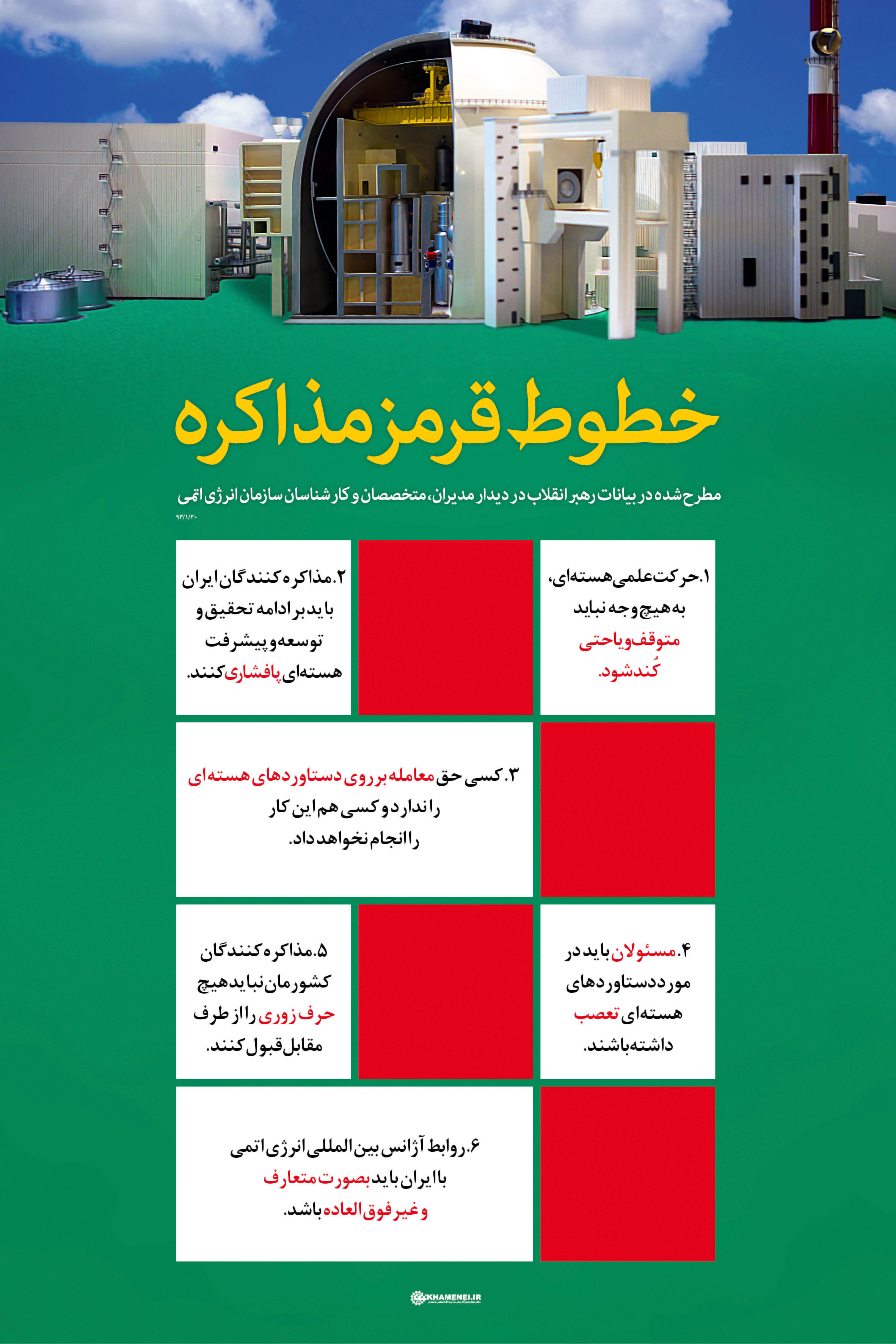
The Rouhani administration’s determination serves in pleasant contrast to the rather stiff and slow Iranian behavior that was especially exhibited during the Ahmadinejad era, but also, at times, in the most favorable of circumstances, during the 2003-05 period, when Rouhani was himself Iran’s chief negotiator. At that time, the Iranian diplomats on the frontline were subjected to a heavy-handed system of control, which tended to stifle their movements. Having learned from this experience, President Rouhani, elected last June, has obtained a carte blanche from Iranian Supreme Leader Ali Khamenei. While the Leader did issue a set of red lines last month (English diagram), and has issued specific warnings every now and then, he has consistently supported Iran’s diplomats while keeping domestic criticism of Iran’s team at a manageable level.
Indeed, Rouhani may not own the horse, but he controls the reins. One of his first acts as president was transferring Iran’s nuclear negotiating file from the Supreme National Security Council to the Ministry of Foreign affairs. That enabled him to build a “dream team” of seasoned negotiators, perfectly comfortable with the codes and practices of their Western counterparts. Iran’s new and refined team has stood out in stark contrast to the collective clumsiness of the P5+1 negotiators, as in the early November 2013 episode, when four Western Foreign Ministers rushed prematurely to Geneva, spurring the media to believe, mistakenly, that a deal would be signed (it was signed 10 days later). But, as Marshal Foch used to say: “After leading a coalition, I have much less admiration for Napoleon…”
Getting to the heart of the matter, many points seem close to being settled. Iran is ready to cap at 5% its production of enriched uranium and to limit its current stockpile from further enrichment. The controversial underground facility of Fordow will probably end up as a kind of research and development unit. The Arak reactor’s original configuration allowed the yearly production of about ten kilograms of plutonium, enough for one or two bombs. Ali Akbar Salehi, chairman of the Atomic Energy Organization of Iran (AEOI), has hinted that this configuration could be modified in order to accommodate low-enriched uranium fuel rather than natural uranium. This would reduce Arak’s plutonium production capacity by a factor of five to ten. And Iran has already confirmed that it has no intention of acquiring the fuel reprocessing capacity indispensable for isolating weapon-grade plutonium.
Depending on the pace of sanctions relief, Iran also seems ready to return to a kind of de factoimplementation of the IAEA’s Additional Protocol, which would provide enhanced monitoring over all of Iran’s nuclear activities. Iran should be ready to initiate the Protocol’s ratification process as soon as the United Nations Security Council shows itself ready to remove the Iranian nuclear file from its agenda, thus erasing the burning humiliation of 2006, when it passed its first resolution on the subject.
The make or break issues
To date, five sticking points remain on the table.
The most difficult issue concerns the format of Iran’s enrichment capacity. The Joint Plan of Action (JPOA), adopted last November, speaks of “parameters consistent with practical needs, with agreed limits on scope and level of enrichment activities”. But the West has focused on “breakout time”, that is, the time needed to acquire enough highly enriched uranium for a first bomb if Iran decided to renege on its commitments. This delay has been estimated at about two months in the current state of Iran’s enrichment program. To extend it significantly, Iran would have to bring down the number of its centrifuges from the present 20,000 to 2-6,000.
A drastic reduction of the number of centrifuges, however, would be a deal-breaker for Iran. Following the conservative elements of the regime, the Supreme Leader has recently excluded any kind of bargaining on Iran’s nuclear achievements.
Fortunately, other solutions can alleviate the West’s concerns. First, having enough highly enriched uranium for one bomb does not mean having the bomb. Several more months would be necessary to make it ready. Second, one wonders why the international community would need more than one or two months to properly respond to an Iranian rush for a bomb. If it can’t make it in two months, why would it succeed in six? Third, this infamous breakout time could be extended without reducing the present number of centrifuges by using, as fast as possible, the low enriched uranium produced by Iran as fuel for nuclear reactors, rendering it unserviceable for further, weapon-grade, enrichmentHere, feeding the Arak reactor with domestic low-enriched uranium could solve a good part of the problem.
It is unfortunate, though, that the Iranians have made so little effort up to now to identify the “practical needs” mentioned, at their initiative, in the Geneva agreement. The spokesman of the AEOI has announced recently that a “comprehensive document” was being elaborated on the subject, and would be submitted for approval to the Iranian Parliament. But this process will probably extend beyond the time limit set for the negotiations.
In the meantime, we know that the Russians are bound to provide for eight more years the low enriched fuel necessary for the Bushehr nuclear plant. After this period, they will resist the introduction of Iranian fuel into the Bushehr reactor, as the selling of fuel is for the Russians the most profitable part of their contract with Iran. Their attitude will be the same when discussing the construction and operation of more reactors in Iran. By all means, new Russian reactors, or any reactors from other origins, will not be active before a decade. All of this is to say that if the current number of 20,000 centrifuges was accepted by the international community, the Iranians would have no “practical need” in the offing to justify a raise of this number in the years to come.
Another difficult point is the question of nuclear research and development. The West would like Iran to forsake such activities, especially in the field of centrifugation. Again, this is a red line for the Supreme Leader and the conservatives, as Iran’s engineers are working on models up to fifteen times more efficient than the present outdated model forming the bulk of its program. Here, a simple solution has been suggested by Salehi: instead of setting a cap on centrifuges, which could be circumvented by using more efficient models, the parties should define this cap in “separative work units”, the equivalent of horsepower in the field of enrichment. The introduction of more efficient centrifuges would thus reduce in due proportion the total number allowed.
A third difficult point is the ongoing exploration by the IAEA of the “possible military dimensions” of Iran’s nuclear program. This demand, reiterated by the IAEA Board of Governors and the UN Security Council, has been fiercely resisted by Iran. In fact, it was the head of the US national intelligence community who said, in 2007, that the Iranian weaponization program was stopped before completion by the end of 2003. Ten years have since passed, and the people involved in that program must have been granted some kind of protection in exchange for their compliance, hence the inherent difficulty for the Iranians of authorizing outsiders to probe too deep into this subject. In former similar occurrences, such as with Egypt, South Korea and Taiwan, the IAEA has accepted not to divulge details on the wrongdoings discovered by its inspectors, once assured of the cancelation of these programs. A similar way out should be explored with Iran.
The fourth sticking point evolves around Iran’s ballistic missiles. The West wants to include them in the negotiations, as a source of worry identified by the UN Security Council, but this has been outright rejected by Iran. Recall that Iran has accepted to negotiate over its nuclear program as a civilian program placed under the aegis of the Nuclear Non-Proliferation Treaty (NPT). Negotiations over missiles pertain to a different world, the world of defense and disarmament, in which negotiations are by definition collective, save for unilateral measures imposed upon a defeated countryIf there is a solution here, it would require a separate, multilateral discussion on the level and distribution of ballistic missiles in the Middle East, with the aim of convincing concerned states to join the International Code of Conduct against Ballistic Missile Proliferation, adopted in 2002 in the Hague.
The last point, little talked about, but hardly the least difficult, concerns the duration of the future comprehensive agreement to be signed by Iran and the P5+1. Under the Geneva JPOA, this agreement, once fully implemented for the duration of all its provisions, will be replaced by the common regime applicable to all NPT members. Iran would then be freed of specific commitments such as the limitation of its enrichment activities, on which extensive IAEA controls, of course, would remain. Such a shift would mean that the International community would be fully reassured about the peaceful nature of the Iranian nuclear program.
However, to reach such an assessment, the general behavior of the Iranian regime and the quality of its relations with the outside world would be as important as the state of its nuclear program. How long should the assessment process last? These considerations cannot be put into writing. The Iranians will probably insist on no more than five years, while the West would be happy to see this regime of special constraints indefinitely extended. This point could be the last outstanding issue in the discussions. Hopefully, if solutions are found on all the previous questions, there will be a strong incentive to find a compromise here to ensure a final deal once and for all.