Affichage des articles dont le libellé est Arak. Afficher tous les articles

Lights and Shadows of the Lausanne Agreement

                                                                                                                 
                                                                                                             April 5, 2015

The results obtained in Lausanne on April 2 in the negotiation between the P5+1 (the five permanent members of the Security Council plus Germany) and Iran represent an outstanding landmark in the long process initiated by the first contacts in 2012 between Iran and the United States under the aegis of the Sultan of Oman. This process was bolstered by the November 24, 2013 Joint Plan of Action establishing the method, the accompanying confidence-building measures, and the end goals of the negotiation of a comprehensive agreement on the Iranian nuclear program. Now, the Lausanne arrangements appear to have removed a significant number of stumbling blocks on the way to such an agreement, allowing us at long last to see the light at the end of the tunnel. Reached through exceptional efforts by the American and Iranian delegations, it can be hailed as a success of the U.S. team led by Secretary of State John Kerry, which displayed an extraordinary amount of perseverance, imagination, and initiative to circumvent Iranian resistance and finally win the day.

At the same time, an analyst owes the truth to its readers. Two documents seem to constitute the visible bulk of the Lausanne arrangements. First, a Joint Statement read successively to the press by EU High Representative Federica Mogherini and Iranian Foreign Minister Javad Zarif; second, a document issued almost simultaneously by the US State Department Press Office, and entitled “Parameters for a Joint Comprehensive Plan of Action (JCPOA) regarding the Islamic Republic of Iran’s Nuclear Program.” The first one is rather short and drafted in general terms. The second is much more detailed, with precise figures, percentages, and time spans, such as the number of first-generation centrifuges allowed to spin over a period of 10 years, or the maximum stockpile of low enriched uranium (3.67% at most) allowed on Iranian soil over a period of 15 years.

Of the two documents, only the first can be considered as being formally agreed by all the parties. The second has been issued unilaterally, under the sole responsibility of the American side. We presume of course that American diplomacy behaves in a responsible way and, therefore, that the Iranian delegation has judged the numerous parameters listed in this document as at least acceptable. But this is the most that we can say. The first paragraph of this second document underlines that these key parameters have been “decided in Lausanne” but does not say by whom exactly. It reminds the reader that these parameters “form the foundation upon which the final text of the JCPOA will be written between now and June 30, and reflect the significant progress that has been made in discussions.” Needless to say, in diplomatic language, there is still a long way between “significant progress in discussions” and a real agreement. And the paragraph concludes with the now consecrated formula: “nothing is agreed until everything is agreed.” In other words, at this point in time, nothing is agreed.

As for the short Joint Statement, which reflects the common understanding of the parties, it speaks indeed of solutions reached on “key parameters,” thus alluding to the American document. But it does not say explicitly that all the delegations have agreed to these solutions. On the positive side, however, the Iranian authorities have not yet raised any formal protest following the publication of the “Parameters” document, which contrasts with what happened in November 2013 after the Americans had issued a similar document giving their own vision of the Joint Plan of Action just agreed upon. This time, Iranian Foreign Minister Zarif tweeted that “The solutions are good for all, as they stand. There is no need to spin using ‘fact sheets’ so early on.” This can be read as a veiled critique of the “Parameters” document but not as an outright rejection. It should also be kept in mind that the Supreme leader, Ali Khamenei, publicly dismissed last February the idea of a two-stage deal, thus preventing the Iranian delegation from joining in Lausanne any kind of interim detailed agreement. All in all, these parameters can certainly be considered as a kind of resource bank for building the final agreement and a basis for discussion for all the parties. But obviously the road to the comprehensive, detailed agreement expected at the end of June will still be hard, bumpy, and full of booby traps.

At the present time, the indisputable bedrock on which the Parties are invited to build an agreement consists only of the formulas found in the Joint Statement:


  • “Iran’s enrichment capacity, enrichment level and stockpile will be limited for specified durations… there will be no other enrichment facility than Natanz;”
  • “Iran’s research and development on centrifuges will be carried out on a scope and schedule that has been mutually agreed;”
  • “Fordow will be converted from an enrichment site into a nuclear, physics and technology centre…There will not be any fissile material at Fordow;” 
  • “A modernized Heavy Water Research Reactor in Arak …will not produce weapons grade plutonium;”
  • “A set of measures has been agreed… including implementation of the modified Code 3.1 and provisional application of the Additional Protocol;”
  • The EU will terminate the implementation of all nuclear-related economic and financial sanctions and the US will cease the application of all nuclear-related secondary economic and financial sanctions, simultaneously with the IAEA-verified implementation by Iran of its key nuclear commitments;”
  • “A new UN Security Council Resolution will endorse the JCPOA, terminate all previous nuclear-related resolutions and incorporate certain restrictive measures for a mutually agreed period of time.” 

This is already plenty, enough to characterize the Lausanne arrangement as a success, and to be optimistic about the final result.

One concluding remark. A silence looms large over the results of the Lausanne meetings. Why do we not find in any of the available documents or the flow of accompanying declarations produced in Lausanne at least a signal encouraging Iran to consider ratifying the Comprehensive Nuclear Test Ban Treaty (CTBT), which forbids all kinds of nuclear explosions for military as well as civilian purposes? As we know, Iran was among the first countries to sign this treaty in 1996 but has not yet ratified it. Its ratification within the framework of the future Comprehensive Plan of Action would be an overwhelmingly positive indication for the international community and provide an added solemn guarantee about the peaceful intentions of Iran in the nuclear field. There is an explanation, of course, for this strange neglect. Two members of the P5+1 group, whose ratification of the Treaty would help it enter into force, still hold back on their own decision: China and the United States. This is how it goes with non-proliferation.

(as published on April 5, 2015 by the Lobelog website : http://www.lobelog.com/lights-and-shadows-of-the-lausanne-agreement/)


Iran Nuclear Deal: Uphill on the Homestretch? (LobeLog, May 5, 2014)

To date, negotiators on both sides of the talks over Iran’s controversial nuclear program, which resume next week, have been remarkably discreet. Even at the political level, people have been unusually quiet. This is an excellent omen. In the past, too many opportunities have been nipped in the bud due to an excess of statements calibrated for domestic purposes (a special mention to Wendy Sherman, the chief US negotiator, for saying so little, amiably, in many background meetings with the press). The involvement of the International Atomic Energy Agency (IAEA) in the negotiations has also been of inestimable value. The Agency offers unique expertise and notarizes regularly the way in which Iran complies with its commitments. It contributes therefore decisively to the smooth progression of the discussions.
Quite unexpectedly, Iran’s negotiators have been the driving force in this process. They have seized President Hassan Rouhani’s initiative to solve the conflict over Iran’s nuclear program and have kept it ever since, setting the targets as well as the tempo. Iran’s foreign minister and lead negotiator, Mohammad Javad Zarif, said on April 7 that the drafting of the final agreement between Iran and the P5+1 (the U.S., Britain, France, China, and Russia plus Germany) should start in May, and that all efforts should be taken to complete the negotiations by the official deadline of July. The Iranians seem set to resolve the conflict over their nuclear program as fast as possible, once and for all.
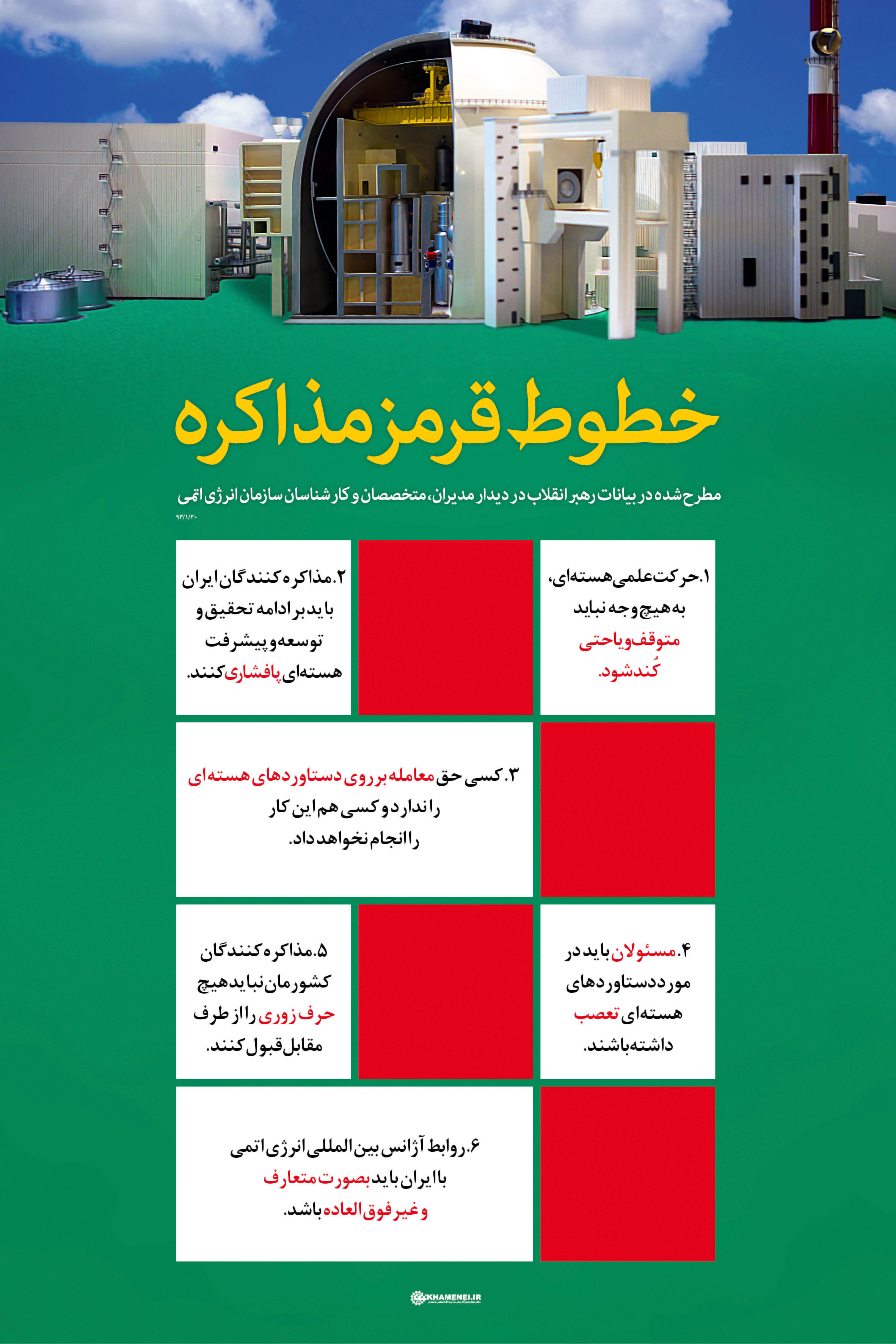
The Rouhani administration’s determination serves in pleasant contrast to the rather stiff and slow Iranian behavior that was especially exhibited during the Ahmadinejad era, but also, at times, in the most favorable of circumstances, during the 2003-05 period, when Rouhani was himself Iran’s chief negotiator. At that time, the Iranian diplomats on the frontline were subjected to a heavy-handed system of control, which tended to stifle their movements. Having learned from this experience, President Rouhani, elected last June, has obtained a carte blanche from Iranian Supreme Leader Ali Khamenei. While the Leader did issue a set of red lines last month (English diagram), and has issued specific warnings every now and then, he has consistently supported Iran’s diplomats while keeping domestic criticism of Iran’s team at a manageable level.
Indeed, Rouhani may not own the horse, but he controls the reins. One of his first acts as president was transferring Iran’s nuclear negotiating file from the Supreme National Security Council to the Ministry of Foreign affairs. That enabled him to build a “dream team” of seasoned negotiators, perfectly comfortable with the codes and practices of their Western counterparts. Iran’s new and refined team has stood out in stark contrast to the collective clumsiness of the P5+1 negotiators, as in the early November 2013 episode, when four Western Foreign Ministers rushed prematurely to Geneva, spurring the media to believe, mistakenly, that a deal would be signed (it was signed 10 days later). But, as Marshal Foch used to say: “After leading a coalition, I have much less admiration for Napoleon…”
Getting to the heart of the matter, many points seem close to being settled. Iran is ready to cap at 5% its production of enriched uranium and to limit its current stockpile from further enrichment. The controversial underground facility of Fordow will probably end up as a kind of research and development unit. The Arak reactor’s original configuration allowed the yearly production of about ten kilograms of plutonium, enough for one or two bombs. Ali Akbar Salehi, chairman of the Atomic Energy Organization of Iran (AEOI), has hinted that this configuration could be modified in order to accommodate low-enriched uranium fuel rather than natural uranium. This would reduce Arak’s plutonium production capacity by a factor of five to ten. And Iran has already confirmed that it has no intention of acquiring the fuel reprocessing capacity indispensable for isolating weapon-grade plutonium.
Depending on the pace of sanctions relief, Iran also seems ready to return to a kind of de factoimplementation of the IAEA’s Additional Protocol, which would provide enhanced monitoring over all of Iran’s nuclear activities. Iran should be ready to initiate the Protocol’s ratification process as soon as the United Nations Security Council shows itself ready to remove the Iranian nuclear file from its agenda, thus erasing the burning humiliation of 2006, when it passed its first resolution on the subject.
The make or break issues
To date, five sticking points remain on the table.
The most difficult issue concerns the format of Iran’s enrichment capacity. The Joint Plan of Action (JPOA), adopted last November, speaks of “parameters consistent with practical needs, with agreed limits on scope and level of enrichment activities”. But the West has focused on “breakout time”, that is, the time needed to acquire enough highly enriched uranium for a first bomb if Iran decided to renege on its commitments. This delay has been estimated at about two months in the current state of Iran’s enrichment program. To extend it significantly, Iran would have to bring down the number of its centrifuges from the present 20,000 to 2-6,000.
A drastic reduction of the number of centrifuges, however, would be a deal-breaker for Iran. Following the conservative elements of the regime, the Supreme Leader has recently excluded any kind of bargaining on Iran’s nuclear achievements.
Fortunately, other solutions can alleviate the West’s concerns. First, having enough highly enriched uranium for one bomb does not mean having the bomb. Several more months would be necessary to make it ready. Second, one wonders why the international community would need more than one or two months to properly respond to an Iranian rush for a bomb. If it can’t make it in two months, why would it succeed in six? Third, this infamous breakout time could be extended without reducing the present number of centrifuges by using, as fast as possible, the low enriched uranium produced by Iran as fuel for nuclear reactors, rendering it unserviceable for further, weapon-grade, enrichmentHere, feeding the Arak reactor with domestic low-enriched uranium could solve a good part of the problem.
It is unfortunate, though, that the Iranians have made so little effort up to now to identify the “practical needs” mentioned, at their initiative, in the Geneva agreement. The spokesman of the AEOI has announced recently that a “comprehensive document” was being elaborated on the subject, and would be submitted for approval to the Iranian Parliament. But this process will probably extend beyond the time limit set for the negotiations.
In the meantime, we know that the Russians are bound to provide for eight more years the low enriched fuel necessary for the Bushehr nuclear plant. After this period, they will resist the introduction of Iranian fuel into the Bushehr reactor, as the selling of fuel is for the Russians the most profitable part of their contract with Iran. Their attitude will be the same when discussing the construction and operation of more reactors in Iran. By all means, new Russian reactors, or any reactors from other origins, will not be active before a decade. All of this is to say that if the current number of 20,000 centrifuges was accepted by the international community, the Iranians would have no “practical need” in the offing to justify a raise of this number in the years to come.
Another difficult point is the question of nuclear research and development. The West would like Iran to forsake such activities, especially in the field of centrifugation. Again, this is a red line for the Supreme Leader and the conservatives, as Iran’s engineers are working on models up to fifteen times more efficient than the present outdated model forming the bulk of its program. Here, a simple solution has been suggested by Salehi: instead of setting a cap on centrifuges, which could be circumvented by using more efficient models, the parties should define this cap in “separative work units”, the equivalent of horsepower in the field of enrichment. The introduction of more efficient centrifuges would thus reduce in due proportion the total number allowed.
A third difficult point is the ongoing exploration by the IAEA of the “possible military dimensions” of Iran’s nuclear program. This demand, reiterated by the IAEA Board of Governors and the UN Security Council, has been fiercely resisted by Iran. In fact, it was the head of the US national intelligence community who said, in 2007, that the Iranian weaponization program was stopped before completion by the end of 2003. Ten years have since passed, and the people involved in that program must have been granted some kind of protection in exchange for their compliance, hence the inherent difficulty for the Iranians of authorizing outsiders to probe too deep into this subject. In former similar occurrences, such as with Egypt, South Korea and Taiwan, the IAEA has accepted not to divulge details on the wrongdoings discovered by its inspectors, once assured of the cancelation of these programs. A similar way out should be explored with Iran.
The fourth sticking point evolves around Iran’s ballistic missiles. The West wants to include them in the negotiations, as a source of worry identified by the UN Security Council, but this has been outright rejected by Iran. Recall that Iran has accepted to negotiate over its nuclear program as a civilian program placed under the aegis of the Nuclear Non-Proliferation Treaty (NPT). Negotiations over missiles pertain to a different world, the world of defense and disarmament, in which negotiations are by definition collective, save for unilateral measures imposed upon a defeated countryIf there is a solution here, it would require a separate, multilateral discussion on the level and distribution of ballistic missiles in the Middle East, with the aim of convincing concerned states to join the International Code of Conduct against Ballistic Missile Proliferation, adopted in 2002 in the Hague.
The last point, little talked about, but hardly the least difficult, concerns the duration of the future comprehensive agreement to be signed by Iran and the P5+1. Under the Geneva JPOA, this agreement, once fully implemented for the duration of all its provisions, will be replaced by the common regime applicable to all NPT members. Iran would then be freed of specific commitments such as the limitation of its enrichment activities, on which extensive IAEA controls, of course, would remain. Such a shift would mean that the International community would be fully reassured about the peaceful nature of the Iranian nuclear program.
However, to reach such an assessment, the general behavior of the Iranian regime and the quality of its relations with the outside world would be as important as the state of its nuclear program. How long should the assessment process last? These considerations cannot be put into writing. The Iranians will probably insist on no more than five years, while the West would be happy to see this regime of special constraints indefinitely extended. This point could be the last outstanding issue in the discussions. Hopefully, if solutions are found on all the previous questions, there will be a strong incentive to find a compromise here to ensure a final deal once and for all.

On the Eve of an Uncertain Negotiation (Lobelog, December 31, 2013)

From recent declarations of President Barack Obama, echoed by French Foreign Minister Laurent Fabius and various American and French officials, one can foresee the initial bargaining position of the Western members of the P5+1 group in the upcoming negotiation with Iran aimed at “a long-term comprehensive solution” to the nuclear crisis.
“We know they don’t need to have an underground, fortified facility like Fordow in order to have a peaceful nuclear program, they certainly don’t need a heavy-water reactor at Arak in order to have a peaceful nuclear program, they don’t need some of the advanced centrifuges that they currently possess in order to have a limited, peaceful nuclear program” stated President Obama on Dec. 7.
“…So the question ultimately is going to be, are they prepared to roll back some of the advancements that they’ve made that could not be justified by simply wanting some modest, peaceful nuclear power, but, frankly, hint at a desire to have breakout capacity.”
In the same vein, Laurent Fabius wrote about one week later: “It is unclear if the Iranians will accept to definitively abandon any capacity of getting a weapon or only agree to interrupt the nuclear program… What is at stake is to ensure that there is no breakout capacity”.
Addressing the two routes to the bomb
It is certainly a legitimate goal to try to erect around the Iranian nuclear program a tight barrier on the two ways that could lead to acquiring a bomb: the enrichment of uranium at the highest levels at Natanz and Fordow, and the production of weapons-grade plutonium by running a research reactor such as the one presently under construction at Arak. But the formulas put forward by President Obama and Foreign Minister Fabius have little chance of persuading the Iranian government. Significantly, they are not reflected in the Nov. 24 agreement that laid the groundwork for the negotiation to come. The final part of the agreement addresses these two points, but in a different way. Regarding enrichment, it asserts the necessity of defining an enrichment program “consistent with practical needs, with agreed limits on scope and level of enrichment activities, capacity… and stocks of enriched uranium.” Concerning the production of weapons-grade plutonium, it affirms the will to “fully resolve concerns related to the reactor at Arak”.
The route to the uranium bomb
What is really at stake? Starting with enrichment, it has been estimated by some that the Iranian enrichment program, with its 19,000 centrifuges, its stock of around seven tons of uranium enriched up to 5% plus a few hundred kilograms of uranium enriched up to 20%, would be able to produce the fissile material necessary for a bomb in just a few weeks; that is, 20 to 25 kilograms of 90% enriched uranium. That would be too short a time for inspectors of the International Atomic Energy Agency (IAEA) to detect such a breakout and for the international community to react effectively. To be on the safe side, according to these estimates, it would be necessary to roll back Tehran’s program. Iran should not possess more than a few thousand centrifuges of its current prevalent model, the IR1, and should not be permitted to produce more efficient models. And it should not retain more than a minimal stockpile of low-enriched uranium available for further enrichment.
But what is the practical value of such estimates? First, having the material for the bomb does not mean having the bomb. Several months, possibly a good year or more, would still be necessary to manufacture and test a first nuclear explosive device. Second, to maintain a minimal deterrent effect after an initial test, at least two or three bombs should be kept in stock. To obtain such a deterrent, however, would significantly add to the time needed for enrichment to 90%. Some argue that as soon as this highly enriched uranium would be produced, and subsequently diverted, it would escape the safeguards of the IAEA, making it much more difficult for the international community to react. But why? The whole country would still be there, both as a possible target for increased sanctions and more. And if a few weeks are theoretically enough for a successful breakout, a few days should be enough to deploy and deliver an adequate response.
Forbidding Iran to develop more efficient models of centrifuges than its first-generation, low-yield, IR1s does not seem realistic either. Such a ban on research can be imposed on a defeated nation. In 1945, Germany, for example, was required to abandon all of its R&D in the field of aircraft engines. But Iran is not in such a position. The limitation of Iran’s enrichment capacities should be addressed, not in terms of numbers and models of centrifuges, but rather in terms of total enrichment capacity (calculated in the nuclear jargon, in separative work units). Once such a ceiling is fixed by mutual consent between Tehran and the P5+1, Iranians scientists and engineers should be left free to make their own technological choices.
As for the small underground enrichment facility of Fordow, it will be hard to convince Iran to close it. Fordow is placed under the same IAEA safeguards as any other Iranian nuclear facility, and being buried 70 yards deep makes no difference. It would make a difference in case of air strikes, but Iran, which is party to the Non-proliferation Treaty (NPT), has no reason to facilitate the destruction of its nuclear facilities, especially by a non-signatory of the NPT, or by any of the five members of the NPT authorized to keep their nuclear arsenals.
On the other hand, it is Iran’s urgent duty to address the widespread suspicions raised by the vagueness of its ambitions when it comes to its nuclear power and research program. Professor Ali Akbar Salehi, head of the Iranian Atomic Energy Organization, recently announced that Iran should produce 150 tons of nuclear fuel to supply five nuclear power plants. Would it be possible to know how exactly, in what time-frame, through which procedures and on what budget such projects are to be implemented? When one knows that 150 tons of idle low-enriched uranium, through further enrichment, is theoretically capable of producing about 150 bombs, the international community is entitled to have access to and thoroughly assess Iran’s plans in this regard.
The route to the plutonium bomb
A word about the plutonium route. The Arak reactor has a design similar to various existing reactors used to produce weapons-grade plutonium, be it in Israel, India or Pakistan. Even if this reactor has little chance to be operational for another three or four years, the concerns about it are legitimate. Furthermore, to recoup the plutonium generated in the reactor’s core, the Iranians would have to build and operate a dedicated side facility. Until now, they have foregone such a possibility. All in all, even with the worst intentions, Iran could hardly produce the first six or seven kilograms of plutonium necessary to build one bomb before the end of the decade. And even so, because of the specific challenges presented by the plutonium route, the time span between the beginning of a possible breakout and the acquisition of a first batch of plutonium would be significantly greater than that of the uranium route.
True, the Arak reactor, once in operation, could not be destroyed without incurring unacceptable nuclear-related damage to the surrounding populations. But this cannot justify a legally indefensible preventive strike on a construction site that has been placed under IAEA safeguards. All in all, the proliferation risk raised by the Arak reactor looks much less pressing than the one generated through uranium enrichment. But it is also true that the best way to permanently alleviate this risk would be to modify, while there is still time, the design of the reactor in order to reduce its capacity to produce weapons-grade plutonium without affecting its other capacities. This is possible with international cooperation, and money.
Suspicion against suspicion
Let us go back to basics. In 1968, the newly signed NPT drew a clear line between licit and illicit nuclear activities for those countries willing to renounce the acquisition of a bomb. For better or worse, that line was drawn at the point before the actual manufacture of a nuclear explosive device. But this was not enough to dispel suspicions of possible breakouts by unruly countries. It has therefore been tried repeatedly — and now again with Iran – to prevent countries from developing the capacities that could theoretically lead to the construction of a bomb. But nations in the forefront of such endeavors have often been among the same ones authorized by the same NPT to retain their nuclear arsenals. It has thus been tempting to interpret their efforts to limit the development of nuclear programs of other nations as an attempt to consolidate their own strategic advantage, especially as they have shown limited enthusiasm for following through on their own NPT commitments to nuclear disarmament. Still another source of suspicion has arisen from the fact that the six members of the P5+1 together comprise the world’s major source of enriched uranium. Their efforts to limit the enrichment capacities of other nations may thus come across as an effort to preserve their own commercial interests.
Even putting aside sources of contention between Iran and the great powers and its regional rivals beyond the nuclear realm, one can see why mutual suspicion still looms so large, even after the breakthrough of the Nov. 24 agreement. To overcome it, vision, restraint, and steady diplomatic work will be critical on both sides in the months to come.