Affichage des articles dont le libellé est missiles. Afficher tous les articles

Security Council Resolutions : Barrier to Iran Nuclear Deal?

This is not the first time that we may have trapped ourselves when drafting UN Security Council (UNSC) resolutions that were intended to trap another country—in this case, Iran. The present situation recalls in some respects the period around 1997 when most Security Council members would have liked to rescind, or at least amend, the sanctions adopted against the regime of Saddam Hussein after the 1991 Gulf War, as their effects were obviously getting out of hand: widespread corruption, and the dramatic deterioration of the Iraqi population’s state of health, to name a couple. But any change in the sanctions would have required unanimity from the five permanent members of the Council, and that was definitely out of reach. The situation led French President Jacques Chirac to express his frustration. “We want to convince, not coerce,” he said. “I have never observed that the policy of sanctions can produce positive effects.”
We have not yet reached such a dramatic juncture with Iran. But should it become useful to rapidly lift the sanctions imposed by the four UNSC resolutions between 2006 and 2010 in order to secure a comprehensive agreement on Iran’s nuclear program, the Western negotiators may find themselves incapable of delivering and may instead try to kick the can down the road to some point in the distant future.
Aimed at halting Iran’s military, nuclear and ballistic activities, these UNSC resolutions are not the ones that hurt the most. More destructive are those unilateral measures imposed by the United States and the European Union, since they were designed essentially to destabilize the Iranian economy. But the UNSC sanctions carry with them a “pillory effect” that the Iranians perceive, quite correctly, as deeply humiliating. They also provide the legal bedrock upon which the European sanctions, in particular, have been constructed. The Iranians are therefore anxious to see them lifted as soon as possible through a decision by the Security Council to close the file it opened in 2006 and return it to the forum from which it should never have been taken: the International Atomic Energy Agency (IAEA).
The conditions for terminating these resolutions, however, are also overwhelming. In fact, the people who drafted them seem to have been pursuing two not necessarily compatible goals at the same time.
The first goal was to pile up all the preconditions that the authors believed were necessary to prevent Iran from acquiring a deliverable nuclear device, including:
-       suspending all activities related to enrichment and reprocessing, including research, development, and construction of new facilities;
-       suspending all activities related to the construction of a heavy-water research reactor;
-       providing immediate access to all sites, equipment, persons and documents requested by the IAEA in order to verify Iran’s compliance with the Security Council decisions and to resolve all outstanding issues related to the possible military dimensions (PMD) of the Iranian nuclear program;
-       promptly ratifying the Additional Protocol to Iran’s safeguards agreement with the IAEA; and
-       suspending all efforts to develop ballistic missiles capable of delivering nuclear weapons.
Considering the context in which these resolutions were adopted, there was little chance that the Iranians would comply with such an elaborate and comprehensive set of so-called “confidence-building measures,” which would have forced Tehran to abandon virtually all of its nuclear and ballistic-missile ambitions.
The second goal was substantively quite different from the first and indeed somehow contradictory. It aimed to push Iran into negotiations, as illustrated by the formula that was included in all the UNSC sanctions resolutions, which ritually expressed the “conviction” that Iran’s compliance “would contribute to a diplomatic, negotiated solution.” Moreover, if Iran suspended its enrichment and reprocessing activities, the Council declared its willingness in return to suspend at least some of its sanctions in order “to allow for negotiations in good faith” and “reach an early and mutually acceptable outcome.”
As we now know, a negotiation process ultimately was initiated, albeit through a radically different path, as the West dropped its demand that Iran fully suspend all its sensitive nuclear activities before entering into substantive talks. One can therefore assume that the second goal will be accomplished as soon as a comprehensive agreement, which will hopefully emerge from the current round of talks in Vienna, enters into force, thus rendering this dimension of the UNSC’s resolutions totally obsolete.
But of course, the resolutions’ first dimension—the exhaustive inventory of “confidence-building measures”—remains in place. Because confidence is essentially an elusive and subjective feeling, taking this path involves embarking on a long-term, winding and always reversible road, the end of which is only faintly discernible now. Such a process is also hardly compatible with the “on-off” mechanism of the Security Council: there is no chance that its resolutions, once cancelled, could be reintroduced. Hence the strong reluctance of the Western powers to commit themselves to such an outcome.
We also all know that the sanctions are much easier to adopt than to rescind, as they tend to create, in the meantime, their own logic and dynamics. They develop new balances of power and vested interests, if only among those in authority who have dedicated themselves so thoroughly to the sanctions’ implementation and enforcement. One has only to recall the notorious example of the general embargo imposed by the Allies against Germany during the First World War whose continuation for several months after the 1918 Armistice unnecessarily prolonged the suffering of the German people and deepened the bitterness of their defeat.
Are Iran’s negotiating partners ready to learn the lessons of history? The Gordian knot that the UNSC sanctions represent should be slashed asunder, if not immediately upon the signing of a comprehensive agreement with Iran, then at least after a moderately short period in which Iran’s determination to comply with its terms could be confirmed. Such a gesture could also be linked appropriately to the formal ratification by Iran’s parliament of the Additional Protocol that Tehran had signed during an unsuccessful round of talks back in 2003—the two moves being equally irreversible.

This would not mean that pending requests made to Iran, such as the ancient issue of the “possible military dimensions” (PMD) of its nuclear program, would have to be abandoned. But it would mean that these requests would thenceforward be dealt with exclusively by the IAEA. It would also mean that the Council, in light of the progress achieved after the signing of a final deal, would no longer consider the Iranian situation a “threat to the peace” under the terms of the UN Charter’s Chapter VII, the only chapter that authorizes the use of coercive measures against a Member State in order “to maintain or restore international peace and security.”

Iran Nuclear Deal: Uphill on the Homestretch? (LobeLog, May 5, 2014)

To date, negotiators on both sides of the talks over Iran’s controversial nuclear program, which resume next week, have been remarkably discreet. Even at the political level, people have been unusually quiet. This is an excellent omen. In the past, too many opportunities have been nipped in the bud due to an excess of statements calibrated for domestic purposes (a special mention to Wendy Sherman, the chief US negotiator, for saying so little, amiably, in many background meetings with the press). The involvement of the International Atomic Energy Agency (IAEA) in the negotiations has also been of inestimable value. The Agency offers unique expertise and notarizes regularly the way in which Iran complies with its commitments. It contributes therefore decisively to the smooth progression of the discussions.
Quite unexpectedly, Iran’s negotiators have been the driving force in this process. They have seized President Hassan Rouhani’s initiative to solve the conflict over Iran’s nuclear program and have kept it ever since, setting the targets as well as the tempo. Iran’s foreign minister and lead negotiator, Mohammad Javad Zarif, said on April 7 that the drafting of the final agreement between Iran and the P5+1 (the U.S., Britain, France, China, and Russia plus Germany) should start in May, and that all efforts should be taken to complete the negotiations by the official deadline of July. The Iranians seem set to resolve the conflict over their nuclear program as fast as possible, once and for all.
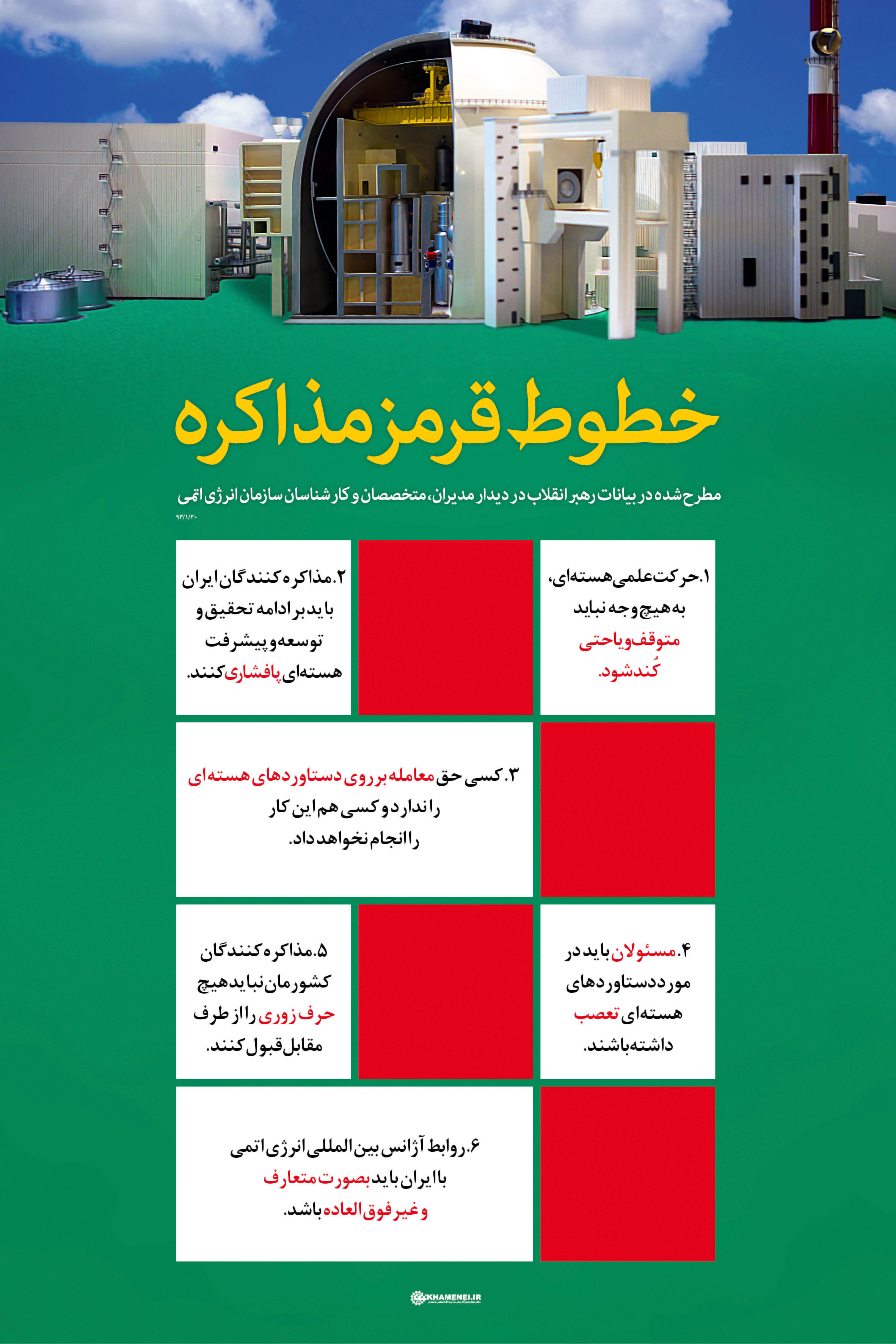
The Rouhani administration’s determination serves in pleasant contrast to the rather stiff and slow Iranian behavior that was especially exhibited during the Ahmadinejad era, but also, at times, in the most favorable of circumstances, during the 2003-05 period, when Rouhani was himself Iran’s chief negotiator. At that time, the Iranian diplomats on the frontline were subjected to a heavy-handed system of control, which tended to stifle their movements. Having learned from this experience, President Rouhani, elected last June, has obtained a carte blanche from Iranian Supreme Leader Ali Khamenei. While the Leader did issue a set of red lines last month (English diagram), and has issued specific warnings every now and then, he has consistently supported Iran’s diplomats while keeping domestic criticism of Iran’s team at a manageable level.
Indeed, Rouhani may not own the horse, but he controls the reins. One of his first acts as president was transferring Iran’s nuclear negotiating file from the Supreme National Security Council to the Ministry of Foreign affairs. That enabled him to build a “dream team” of seasoned negotiators, perfectly comfortable with the codes and practices of their Western counterparts. Iran’s new and refined team has stood out in stark contrast to the collective clumsiness of the P5+1 negotiators, as in the early November 2013 episode, when four Western Foreign Ministers rushed prematurely to Geneva, spurring the media to believe, mistakenly, that a deal would be signed (it was signed 10 days later). But, as Marshal Foch used to say: “After leading a coalition, I have much less admiration for Napoleon…”
Getting to the heart of the matter, many points seem close to being settled. Iran is ready to cap at 5% its production of enriched uranium and to limit its current stockpile from further enrichment. The controversial underground facility of Fordow will probably end up as a kind of research and development unit. The Arak reactor’s original configuration allowed the yearly production of about ten kilograms of plutonium, enough for one or two bombs. Ali Akbar Salehi, chairman of the Atomic Energy Organization of Iran (AEOI), has hinted that this configuration could be modified in order to accommodate low-enriched uranium fuel rather than natural uranium. This would reduce Arak’s plutonium production capacity by a factor of five to ten. And Iran has already confirmed that it has no intention of acquiring the fuel reprocessing capacity indispensable for isolating weapon-grade plutonium.
Depending on the pace of sanctions relief, Iran also seems ready to return to a kind of de factoimplementation of the IAEA’s Additional Protocol, which would provide enhanced monitoring over all of Iran’s nuclear activities. Iran should be ready to initiate the Protocol’s ratification process as soon as the United Nations Security Council shows itself ready to remove the Iranian nuclear file from its agenda, thus erasing the burning humiliation of 2006, when it passed its first resolution on the subject.
The make or break issues
To date, five sticking points remain on the table.
The most difficult issue concerns the format of Iran’s enrichment capacity. The Joint Plan of Action (JPOA), adopted last November, speaks of “parameters consistent with practical needs, with agreed limits on scope and level of enrichment activities”. But the West has focused on “breakout time”, that is, the time needed to acquire enough highly enriched uranium for a first bomb if Iran decided to renege on its commitments. This delay has been estimated at about two months in the current state of Iran’s enrichment program. To extend it significantly, Iran would have to bring down the number of its centrifuges from the present 20,000 to 2-6,000.
A drastic reduction of the number of centrifuges, however, would be a deal-breaker for Iran. Following the conservative elements of the regime, the Supreme Leader has recently excluded any kind of bargaining on Iran’s nuclear achievements.
Fortunately, other solutions can alleviate the West’s concerns. First, having enough highly enriched uranium for one bomb does not mean having the bomb. Several more months would be necessary to make it ready. Second, one wonders why the international community would need more than one or two months to properly respond to an Iranian rush for a bomb. If it can’t make it in two months, why would it succeed in six? Third, this infamous breakout time could be extended without reducing the present number of centrifuges by using, as fast as possible, the low enriched uranium produced by Iran as fuel for nuclear reactors, rendering it unserviceable for further, weapon-grade, enrichmentHere, feeding the Arak reactor with domestic low-enriched uranium could solve a good part of the problem.
It is unfortunate, though, that the Iranians have made so little effort up to now to identify the “practical needs” mentioned, at their initiative, in the Geneva agreement. The spokesman of the AEOI has announced recently that a “comprehensive document” was being elaborated on the subject, and would be submitted for approval to the Iranian Parliament. But this process will probably extend beyond the time limit set for the negotiations.
In the meantime, we know that the Russians are bound to provide for eight more years the low enriched fuel necessary for the Bushehr nuclear plant. After this period, they will resist the introduction of Iranian fuel into the Bushehr reactor, as the selling of fuel is for the Russians the most profitable part of their contract with Iran. Their attitude will be the same when discussing the construction and operation of more reactors in Iran. By all means, new Russian reactors, or any reactors from other origins, will not be active before a decade. All of this is to say that if the current number of 20,000 centrifuges was accepted by the international community, the Iranians would have no “practical need” in the offing to justify a raise of this number in the years to come.
Another difficult point is the question of nuclear research and development. The West would like Iran to forsake such activities, especially in the field of centrifugation. Again, this is a red line for the Supreme Leader and the conservatives, as Iran’s engineers are working on models up to fifteen times more efficient than the present outdated model forming the bulk of its program. Here, a simple solution has been suggested by Salehi: instead of setting a cap on centrifuges, which could be circumvented by using more efficient models, the parties should define this cap in “separative work units”, the equivalent of horsepower in the field of enrichment. The introduction of more efficient centrifuges would thus reduce in due proportion the total number allowed.
A third difficult point is the ongoing exploration by the IAEA of the “possible military dimensions” of Iran’s nuclear program. This demand, reiterated by the IAEA Board of Governors and the UN Security Council, has been fiercely resisted by Iran. In fact, it was the head of the US national intelligence community who said, in 2007, that the Iranian weaponization program was stopped before completion by the end of 2003. Ten years have since passed, and the people involved in that program must have been granted some kind of protection in exchange for their compliance, hence the inherent difficulty for the Iranians of authorizing outsiders to probe too deep into this subject. In former similar occurrences, such as with Egypt, South Korea and Taiwan, the IAEA has accepted not to divulge details on the wrongdoings discovered by its inspectors, once assured of the cancelation of these programs. A similar way out should be explored with Iran.
The fourth sticking point evolves around Iran’s ballistic missiles. The West wants to include them in the negotiations, as a source of worry identified by the UN Security Council, but this has been outright rejected by Iran. Recall that Iran has accepted to negotiate over its nuclear program as a civilian program placed under the aegis of the Nuclear Non-Proliferation Treaty (NPT). Negotiations over missiles pertain to a different world, the world of defense and disarmament, in which negotiations are by definition collective, save for unilateral measures imposed upon a defeated countryIf there is a solution here, it would require a separate, multilateral discussion on the level and distribution of ballistic missiles in the Middle East, with the aim of convincing concerned states to join the International Code of Conduct against Ballistic Missile Proliferation, adopted in 2002 in the Hague.
The last point, little talked about, but hardly the least difficult, concerns the duration of the future comprehensive agreement to be signed by Iran and the P5+1. Under the Geneva JPOA, this agreement, once fully implemented for the duration of all its provisions, will be replaced by the common regime applicable to all NPT members. Iran would then be freed of specific commitments such as the limitation of its enrichment activities, on which extensive IAEA controls, of course, would remain. Such a shift would mean that the International community would be fully reassured about the peaceful nature of the Iranian nuclear program.
However, to reach such an assessment, the general behavior of the Iranian regime and the quality of its relations with the outside world would be as important as the state of its nuclear program. How long should the assessment process last? These considerations cannot be put into writing. The Iranians will probably insist on no more than five years, while the West would be happy to see this regime of special constraints indefinitely extended. This point could be the last outstanding issue in the discussions. Hopefully, if solutions are found on all the previous questions, there will be a strong incentive to find a compromise here to ensure a final deal once and for all.